Showing posts with label Wild Food and Foraging. Show all posts
Friday, 4 May 2012
Wild Garlic and How to Get It
I don't get out much. I am not a hermit though and I do enjoy going out, providing the circumstances are right. A day of fresh air and countryside is preferable to traipsing around the shops as I would rather dodge insects and tree branches than hapless retail enthusiasts.
I've been very busy lately running a business which has kept me indoors probably too much, but as it revolves around food, I've not been unhappy, but I would have liked to have gone out and foraged for some wild garlic.
As part of my work entails much use of social media I was lucky enough to encounter a generous person on Twitter who offered to post me some wild garlic after seeing my tweet asking if anyone knew of good foraging sites in North Herts.
A packet arrived promptly and intact from Bere Marsh Farm. I was initially concerned that the fresh-picked leaves might not make the journey from Dorset, but Royal Mail had been careful not to squash them.
Fiona Gerardin sells packs of her organic wild garlic on eBay, which is a good thing to know, if you want to try it, but can't get to somewhere to collect it yourself.
From my quick research I know that wild garlic (latin name: allium ursinum) also known as ramsoms, grows in moist woodland areas and flowers in the spring before most trees have regained their leaves.
Many experienced foragers will tell you that you can follow your nose to a patch. The strong garlic scent is a dead giveaway and fortunately for this reason, makes for reliable identification. Be careful though, not to confuse it with lily of the valley which is highly toxic. Take a leaf, crush it, smell it. Smells of garlic? Than you have the right one. No smell, then best leave it.
I should point out that if you do decide to collect food plants from the wild, you should get permission from the landowner and only carefully pick what you need and never uproot plants. Nature and the environment need respect, also you would want to return the following year to the same flourishing patch, wouldn't you?
Much like bulb garlic, wild garlic can be used the same way in cooking. I made a pesto with it which had a strong garlic flavour and the added fresh green flavour from the juicy leaves. The risotto, I made was good too. The leaves I added towards the end of cooking to preserve their colour. They were jolly good in Chinese stir-fries as well.
What seemed to be a small packet contained more than it first appeared and I discovered that wild garlic leaves store well in the salad drawer of the fridge.
Maybe next year I'll be able to get out into the woods and go wild garlic hunting for myself or failing that, I'll just have to grow it in the garden.
Labels:
Bere Marsh Farm,
Ramsoms,
Wild Food and Foraging,
Wild Garlic
Tuesday, 29 June 2010
Beauty in the Brine
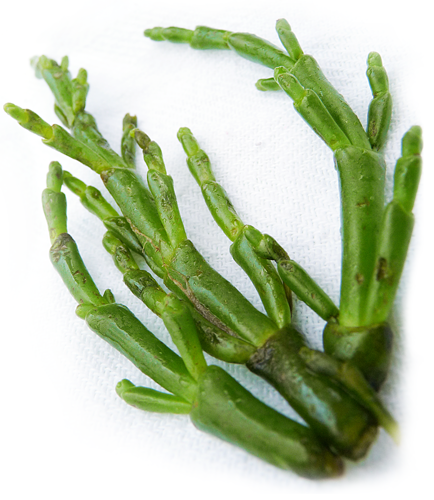
I fell in love with a coastal delicacy last year that has kept me drooling in anticipation for the next season of marsh samphire to return. The small fleshy leaved plant that inhabits the marshes and tidal mudflats of Britain’s shores is very much seasonal and as yet still a wild and uncultivated plant, thus making it a very special food from June until the end of August.
It is gathered by hand, an arduous and back-aching task, by fishermen and shore workers to supplement their summer income.
When I was in North Norfolk, last year, I saw it growing and was tempted to pull on my wellies and venture out into the squelchy mud to pick some for myself. I’m aware that it is not always acceptable to do so, although it is not illegal, one has to consider respect for nature and the environment, especially as the samphire grows on protected habitats.
For this reason, the best samphire grounds are kept secret and only those with permission have access to the green bounty.
Samphire is a type of succulent, perfect for tolerating the salt from each inundating tide. It has short branching stems, with a strange joint-like structure that reminds me of little alien antennae.
As I don’t live on the coast, I don’t often get the chance to buy it. It’s a rare thing to find in the shops around my way, so I almost fell over with excitement when the fish stall at my monthly farmers market was selling it. I bought a couple of generous man-sized handfuls.
Good, fresh samphire should be bright green and shiny, still engorged with moisture. Avoid any that looks dull or withered. It should also smell fresh, tinged with the scent of sea air.
Before eating, it is important to wash it thoroughly in cold water to remove any gritty sand and silt. I took three good washings and drainings to get mine clean.
Samphire doesn’t take much cooking, you can indeed eat it raw, but I like to drop it briefly into boiling water, drain and toss in butter. Don’t add salt to the water and use unsalted butter – the samphire has been seasoned perfectly well by the sea. Finish with a grind of black pepper and eat.
Obviously, samphire is an ideal accompaniment to fish, being juicy, clean flavoured, with just a hint of the briny blue. The very essence of all that is good about our wild coastline.
Labels:
"Spouse Specials",
Coast,
Fish,
Marsh,
Marsh Samphire,
Salt Marsh,
Saltmarsh,
Samphire,
Sea,
Shellfish,
Vegetables,
Wild Food and Foraging
Saturday, 12 June 2010
Elderflower Cheesecake
Highly perfumed lacy umbels are adorning the elder trees, begging to lend they're unique flavour to my cooking.
I have tried all the usual recipes from jellies to cordials and everything in between, but I was longing to try something different, which led me to research some ancient uses for the woodland flowers.
During Medieval times, something called Sambocade was prepared as a dessert using curd cheese baked in a tart case. This immediately struck me as something I'd like to make. I doubt my version is anything like the original, but as an experiment, it turned very well indeed, if I may say so myself.
The pastry makes a nice crispy container for the soft, light, fragrant and fluffy cheesecake-like filling. It is not like your usual baked cheesecake, as the texture is not as dense, but I think the lighter consistency makes it all the more summery.
I was perhaps a little lazy on this occasion, as I didn't make my own pastry, but good quality shop bought pastry is just fine and saves some time.
Don't wash your elderflowers, as that will remove all the vital pollen that is essential in giving the wonderful taste, just shake the flower heads to remove any bugs and inspect them carefully. It pays not to be too squeamish, with some insects being so tiny, it is inevitable that you'll end up eating some of them!
Ingredients
500g sweet shortcrust pastry
250g ricotta cheese
2 medium eggs, separated
100g caster sugar
2 tblsp plain flour
2 tblsp double cream
grated zest 1 lemon
3-4 large elderflower heads
Method
Preheat the oven to 190C / 375F / Gas 5.
Roll out the pastry to about 4mm thick and use to line a 20cm round non-stick spring form tin. Work the pastry in so that it fits nicely. It doesn't matter if there are a few folds, just make sure to avoid any holes, although these can be patched up with spare pastry. Leave the pastry roughly hanging over the edges at the top – no need to trim as this will crumble away later for a rustic look. Put into the oven and bake blind for about 10 minutes.
Now the fiddly bit. Pick all the tiny flowers off the stems, discarding the thick green parts. You should now a have a nice pile of free flowing flowers. Set to one side.
In a large bowl, beat together the ricotta cheese, egg yolks, caster sugar, plain flour, double cream and lemon zest. When it is smooth and glossy, stir in the elderflowers and mix well. Set aside.
In another bowl beat the egg whites until they are stiff.
Take a small amount of egg white and stir well into the elderflower mixture. Fold the remaining egg white in, a little at a time, taking care not to knock out the air. When it is all well incorporated, pour into the pastry case and bake in the centre of the oven for about 1 hour.
When the cake is ready it should be risen and golden on top and wobble slightly.
Switch off the oven, but leave the cheesecake in with the door open to cool. The cake will sink slightly with some cracking, but this is normal.
When completely cool, remove from the tin and transfer to a serving plate.
Keep refrigerated.
Photos: ©childsdesign 2010
Saturday, 13 June 2009
Elderflower and Apple Jelly

I couldn't help noticing how the elderflowers are now filling the air with their heady scent and this inspired me to use them in cooking again. Last year I made some delicious fritters, but this time I wanted to make something more long lasting.
Elderflowers have such a gorgeous flavour and here I have used them to make an apple jelly preserve which could work well as either an accompaniment to pork, maybe even cheese or simply spread on some bread.
At first it seems like there's a lot involved in making the jelly, but I can assure you, it is well worth it.
The cooked fruit and flower pulp has to be placed in a cloth bag overnight to allow the juice to drain through. Not having a jelly bag or brand new piece of muslin to hand, I found an old muslin curtain and used that, obviously after I had washed it very well!
The bag has to be suspended above the bowl so that the weight of its contents pushes through the liquid. My husband kindly rigged up a pole across a couple of stands, I suppose a broom handle over two chairs would work just as well.
The cooked fruit and flower pulp has to be placed in a cloth bag overnight to allow the juice to drain through. Not having a jelly bag or brand new piece of muslin to hand, I found an old muslin curtain and used that, obviously after I had washed it very well!
The bag has to be suspended above the bowl so that the weight of its contents pushes through the liquid. My husband kindly rigged up a pole across a couple of stands, I suppose a broom handle over two chairs would work just as well.
Ingredients
1 kg bramley apples
20-30 heads of elderflowers
3 lemons juiced
preserving sugar (75g of sugar for every 100ml of juice)
Equipment
Method
Check your freshly picked elderflowers for any creepy crawlies. Do not wash them, but give them a good shake to dislodge any insects.
3 lemons juiced
preserving sugar (75g of sugar for every 100ml of juice)
Equipment
a large piece of muslin cloth
a long pole and something to rest it across
sterilised jars to store it in (mine filled two Bonne Maman jam jars each containing 370g)
Method
Check your freshly picked elderflowers for any creepy crawlies. Do not wash them, but give them a good shake to dislodge any insects.
Chop the apples, leaving on the skin and put into a large pan, cores and all, with the flowers.
Add some water so that it just covers the fruit and flowers and bring the ingredients to the boil and cook them until the apples are very soft and mushy.
Now for the 'fun' part:
Take a large bowl and place a colander in it. Next line the colander with the muslin cloth and carefully pour in the apple mush. You now need to gather the corners of the cloth and tie them over a pole (see photo below). Be careful not to squeeze the muslin bag.
Leave your 'contraption' overnight to allow all the juice to drip through.
Next day discard the contents of the bag. Check the quantity of juice and measure out 75g of sugar for every 100ml of liquid.
Put the liquid in to a heavy pan and add the lemon juice.
Bring the juice to the boil and then add the sugar, letting it dissolve into the liquid.
Bring it up to a rapid boil for at least 15 minutes.
Next day discard the contents of the bag. Check the quantity of juice and measure out 75g of sugar for every 100ml of liquid.Put the liquid in to a heavy pan and add the lemon juice.
Bring the juice to the boil and then add the sugar, letting it dissolve into the liquid.
Bring it up to a rapid boil for at least 15 minutes.
Check the setting point (see How To guide) and when it is ready, pour into sterilsed jars.
Sunday, 3 May 2009
Bramble and Bramley Jam

I finally got around to making some blackberry jam and the results from last year's foraging have survived the cold confines of the freezer.
This weekend we have been busy in the front garden clearing a tangle of brutish brambles to make way for some raised vegetable beds. Battling away and getting scratched and spiked in the process, reminded me of last year and the thought of "I must make that jam" quickly entered my mind.
What I like about this particular jam is that it is seedless. Blackberries can be so full of pips and this doesn't always make it a pleasurable eating experience, especially when you get them stuck in between your teeth.
The addition of apples adds another dimension to the flavour and bulks out the texture too.
1kg blackberries
350g bramley apples
water
white granulated sugar
Method
Core and roughly chop the apples leaving the skin on.
Put the apples and blackberries in a large preserving pan or large heavy bottomed saucepan. Add just enough water to cover and simmer until soft.
Put the sieved pulp and sugar into a large heavy bottomed saucepan or preserving pan and heat very gently until the sugar has dissolved.
Bring the jam to the boil and continue to boil very rapidly for about 8-10 minutes until the jam reaches setting point. See tip below.
When the jam has set, carefully pour into warm, sterilised jars, using a ladle.
Cover the jars with tight fitting screw-top lids.
Label when cold and store in a cool, dark place, away from damp.
Tricks and Tips: Jam setting point 
Achieving the right set does carry a certain knack to it. You could try using a jam thermometer but personally I find it a lot easier using a method that my maternal Grandma showed me. Before you start to make the jam, put a plate in the fridge. When it's cold you then drizzle some warm jam on to it and return the plate to the fridge to cool for approximately two minutes. You can tell that it has set when you run your finger through it leaving a crinkly track mark. If after two minutes the cooled jam is too runny, continue to boil the jam, testing it every few minutes until you have the right set.

Achieving the right set does carry a certain knack to it. You could try using a jam thermometer but personally I find it a lot easier using a method that my maternal Grandma showed me. Before you start to make the jam, put a plate in the fridge. When it's cold you then drizzle some warm jam on to it and return the plate to the fridge to cool for approximately two minutes. You can tell that it has set when you run your finger through it leaving a crinkly track mark. If after two minutes the cooled jam is too runny, continue to boil the jam, testing it every few minutes until you have the right set.
Saturday, 30 August 2008
Brambles and Berries
As I was updating my ‘In Season’ list, it occurred to me that we are indeed entering another season.
It is a sad but very true fact that the disappointing summer is on its way out and autumn is hot on its heels. Autumn though, is not a season to be sniffed at, bringing with it luscious hedgerow fruits, wild mushrooms and fiery colours.
As I write though, the weather has taken a turn for the better, albeit for a short time before the forecasted thunderstorms and rain arrive.
Earlier in the year I plundered our overgrown garden for elderflowers to make some fritters (click to see post).
The remaining blossoms have now developed into fruits and I’m eager to pick them to make elderberry jelly or jam. Dashing into the garden with my camera to take some photos for blog documentation, I’m suddenly disappointed. The birds have got there before me! There’s hardly a berry left and all that remains are the spikey magenta stalks.

This is going to be a prickly challenge, but being scratched isn’t going to prevent me from gathering nature’s prize.
The blackberries are bloated and juicy and I pick them one by one, staining my fingers a dark purple.
The task takes me quite some time. There are a lot of berries on offer and it frustrates me that so many are out of reach. Not wanting to risk falling into the spiny nest of barbed stems, I decide to leave those ones for the birds.
Satisfied that I’ve gathered enough, I weigh them. A pound and a half! That’s pretty good; and I didn’t have to go very far to get them.
Wild blackberries invariably act as homes for some invertebrate wildlife, so I drop the blackberries into some salted cold water and leave them to soak overnight. This has the desired effect of evicting the unwanted beasties which can be rinsed off later.
I’m not sure what I’d like to do with the berries yet, but they freeze well, so until I decide whether to make an apple and blackberry pie or jam, they’ll keep in the meantime.
It is a sad but very true fact that the disappointing summer is on its way out and autumn is hot on its heels. Autumn though, is not a season to be sniffed at, bringing with it luscious hedgerow fruits, wild mushrooms and fiery colours.
As I write though, the weather has taken a turn for the better, albeit for a short time before the forecasted thunderstorms and rain arrive.
Earlier in the year I plundered our overgrown garden for elderflowers to make some fritters (click to see post).
The remaining blossoms have now developed into fruits and I’m eager to pick them to make elderberry jelly or jam. Dashing into the garden with my camera to take some photos for blog documentation, I’m suddenly disappointed. The birds have got there before me! There’s hardly a berry left and all that remains are the spikey magenta stalks.
My despondency soon fades as I realise that the thorny entanglement I’ve had to fight through is a mass of brambles now covered in fruit, ripe and ready for picking.
Back into the house to fetch a bowl from the kitchen.
This is going to be a prickly challenge, but being scratched isn’t going to prevent me from gathering nature’s prize.The blackberries are bloated and juicy and I pick them one by one, staining my fingers a dark purple.
The task takes me quite some time. There are a lot of berries on offer and it frustrates me that so many are out of reach. Not wanting to risk falling into the spiny nest of barbed stems, I decide to leave those ones for the birds.
Satisfied that I’ve gathered enough, I weigh them. A pound and a half! That’s pretty good; and I didn’t have to go very far to get them.Wild blackberries invariably act as homes for some invertebrate wildlife, so I drop the blackberries into some salted cold water and leave them to soak overnight. This has the desired effect of evicting the unwanted beasties which can be rinsed off later.
I’m not sure what I’d like to do with the berries yet, but they freeze well, so until I decide whether to make an apple and blackberry pie or jam, they’ll keep in the meantime.
Labels:
Blackberries,
Blackberry,
Elderberries,
Elderberry,
Fruit,
Stories,
Wild Food and Foraging
Sunday, 8 June 2008
From Foraging to Fritters
I knew there was a good reason to let part of the front garden to be given over to nature.We haven't intentionally neglected to maintain its upkeep, but there never seems to be enough time to tackle the enormous task of clearing the undergrowth and clipping the hedges, As a result a rather large elder bush has grown up through the hornbeam hedge


It is now in full flower, and not wanting to miss the opportunity to eat some it's blossom, I battled my way past the prickly brambles to pick its headily scented blooms.
They are best gathered in the morning after some sun has shone on them - this is when the flowers pack out the most scent and flavour.
Avoid washing the blooms as this will just make them soggy and lose their gorgeous Muscat flavour. It's best to simply shake them to dislodge any creepy-crawlies, unless of course you fancy some added protein!
I make a light tempura style batter, dipping in the elderflower heads and deep fry for a couple of minutes until they are golden and crispy. A sprinkling of caster sugar to finish and then eat.
I have decided to leave the elder bush to go on to produce berries later in the year, these being very useful for jams and jellies.
Subscribe to:
Posts (Atom)