Showing posts with label Vegetarian. Show all posts
Saturday, 1 October 2011
Butternut Squash & Chickpea Curry
Sometimes I don't want a curry that is too rich or heavy, but I still want a good depth of flavour. I think this recipe is Bengali in origin. It uses an Indian five-spice blend called Panch Phoran. The spices are left whole so you get nice little flavour bursts with every mouthful that perfectly complement the fresh sweetness of the butternut squash and the round earthiness of the chickpeas.
The dash of fresh ground fennel seeds at the end really gives the dish a brightness and wonderful aniseed aroma.
Serves 4
Ingredients
1tbsp vegetable oil
1 bay leaf
1/2 tsp panch phoran (see my 'how to make it' if you'd like to make your own)
1-2 green chillies, cut in half lengthways and deseeded
1 small onion chopped
1/2 tsp tumeric
2 tsp ground cumin
1 heaped tsp ground coriander
thumb sized piece ginger, grated
salt to taste
sugar to taste
500g butternut squash, peeled, seeds removed and cut into 2cm pieces
200ml boiling water
200g cooked chickpeas
1 tsp ground garam masala
1 tsp fennel seeds, ground to a powder
Method
In a large heavy frying pan, heat the oil and add the bay leaf, panch phoran, chillies and fry gently for 1-2 minutes until the seeds begin to pop
Add the chopped onion and stir well to coat with the spices. Fry gently until very soft and translucent.
Add the tumeric, ginger paste, cumin and coriander, salt and sugar and a splash of water and cook for 1-2 minutes
Add the butternut squash and the boiling water. Bring to the boil and then turn down the heat to a simmer and cook for 15 minutes. Cook until the squash is tender but don't allow it to become mushy.
Stir in the chickpeas, garam masala and ground fennel. Cook for about 1-2 minutes until the chickpeas are warmed through and everything is well combined.
Serve with basmati rice and yogurt.
Photo: ©childsdesign 2011
Thursday, 19 May 2011
Beyond the Garnish
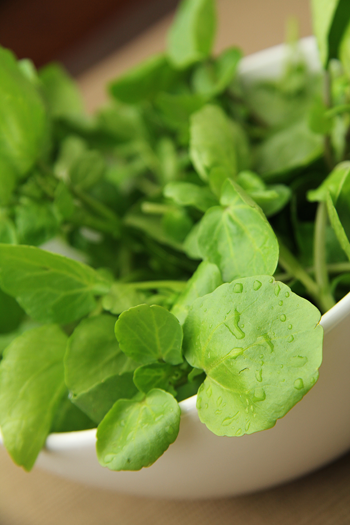
Could watercress be the next superfood? Historically it is known to be a blood cleanser and more recently there have been suggestions that it could help to suppress certain cancers. Watercress does indeed contain lots of vitamins and minerals as well as antioxidant properties which are all good for our health. That said, it tastes so good and is versatile enough to be used in so many ways that it shouldn’t need to be bolstered by a health PR campaign to make us eat it.
It may be an acquired taste for some people, the peppery flavour can be quite strong and might be a shock to younger palates. My Dad used to stuff it generously into sandwiches, but it was only after several tries that I grew to like it.
Hertfordshire has long been known for commercially cultivating watercress, the Sansom family have been doing so for five generations and Nine Wells Farm in Whitwell near Hitchin, is probably the closest producer to us here in Letchworth.
It is nice to think that we have a plentiful supply on our doorstep, so expect to find it in local delicatessens, farm shops and greengrocers. I have even found bags of supermarket watercress with ‘Herts’ as the place of origin, so you never know.
May sees watercress being celebrated with its very own ‘week’, the perfect time to explore this humble leafy plant. Experiment with it and don’t just leave it to languish as an undervalued salad garnish on the side of the plate.
Having such a robust almost mustard-like taste, it can be used very much as an ingredient, giving flavour as well as the crunchy juicy texture coming from the stalks.
Try it roughly chopped and stirred through mashed potatoes or it makes an interesting filling for an omlette along with some mushrooms and Stilton cheese.
I’ve even made pesto using it, instead of basil, which is lovely stirred through some pasta with smoked salmon.
Watercress Soup
To extract all the gorgeous green goodness, a watercress soup is refreshing and an ideal lunchtime treat, but it is also elegant enough to serve as a dinner party starter.
Take care not to overcook the soup once the watercress is added as this will destroy the flavour and the colour may not be so appealing.
Ingredients
1 onion, peeled and roughly chopped
25g butter
250g potatoes, peeled and diced
600ml chicken or vegetable stock
2 x bags (about 150g) of watercress, roughly chopped
50ml cream
a little milk if needed
salt and black pepper
Method
In a large pan gently melt the butter, add the onion and cook the onion until soft and translucent but not browned.
Add the potatoes and stock and cook until the potatoes are soft, for approximately 15-20 minutes. When potatoes are almost cooked, add the watercress and cook no longer than 5 minutes. Tip into a liquidiser, add the cream and blend until smooth. Use a little extra milk if the soup seems too thick. Season with salt and black pepper and serve hot. Drizzle with some extra cream to serve.
Food photos: ©childsdesign 2011
My article previously published in Letchworth Living magazine. (May 2011 edition) www.letchworthliving.co.uk
Thursday, 21 October 2010
Gaia's Kitchen and The Use-It-All Cookbook
I'm going to start off by saying that vegetarian food is not boring, well at least not if you make it yourself.
It is not uncommon for me to eat at least three meat-free meals each week and that has nothing to do with principles, morals, ethics or the like, but because meat can be expensive and I don't always want it.
It is possible to have a vegetarian dish and not miss meat at all.
Gaia's Kitchen is all about wholesome natural food, after all that is what food should be about, I know I'd rather avoid unnecessary additives and suspect ingredients.
Most people immediately think of lentils when vegetarian food is mentioned, they are right of course, but lentils are not bland or insipid if they are cooked with care and a smattering of herbs and spices.
From the minds and kitchens of Schumacher College in Dartington,
Gaia's Kitchen teaches us about the importance of respecting the Earth and ourselves through our choice of food. Some might think of this as a hippy ideal, but issues concerning ecology and sustainability could not be more important in this day and age.
The intention of the recipes is to feed lots of hungry people –
the quantities for some are huge and all of the dishes include a version to allow the cook to scale up the ingredients to serve around 40 people!
Well it does state on the cover that they are for family and community.
As I was cooking just for two, I reduced the amounts accordingly, without detriment to the final result.
I made two recipes, the Spinach & Mushroom Plait (p.71) and Marilyn's Vegan Chocolate Cake (p.186). Both recipes were easy to follow and liked the diagrams to show you exactly how to create the pastry plait work.
Spinach & Mushroom Plait
The Spinach & Mushroom Plait was rich, intense and mushroomy,
the mushrooms are cooked down quite a lot which magnifies their flavour. The addition of cheddar cheese gave it an agreeable savouriness.
Marylin's Vegan Chocolate Cake
The chocolate cake was a revelation, being vegan, it can't contain any dairy products, so that meant no butter or eggs. The fat is replaced with vegetable oil, but believe it or not, it is possible to make a cake without eggs. The texture was dense but appropriate for a chocolate cake. My only comment would be that it should have more cocoa as it wasn't quite chocolatey enough for me.
This is a good book for those looking for more vegetarian options to
add to their repertoire and many of the dishes would hold up well at a dinner party.
The second book, The Use-It-All Cookbook is one I feel everyone should own. These days, so much food is wasted, either because we think it has gone off, when it really hasn't, or we don't know what to do with left-overs or the last carrot in the veg trolley.With hints and tips on planning, storage, reheating, to the mysteries of the use-by date, the book could save you money and feed you well.
It is filled with recipes from the basics to savoury to sweet and is simple
to use when looking for something to use up like cold roast chicken or mashed potato.
Although the book encourages frugality it is far from austere in terms of cuisine. Good family cooking at its best.
Gaia's Kitchen by Julia Ponsonby is published by Green Books
The Use-It-All Cookbook by Bish Muir is published by Green Books
Order yours now
Food photos: ©childsdesign 2010
Books kindly supplied by Green Books
Sunday, 17 October 2010
Alternative Roots
I often find roasting preferable to boiling when cooking carrots, firstly it intensifies their sweetness and secondly it gives me scope to add other enhancing ingredients.
Carrots can be partnered with a multitude of of flavourings and this time I paired them with a combination of shredded fresh ginger and crushed coriander seeds. The fragrant lemon-like zestiness works really well with the almost caramelised quality of the bright orange roots, I also like the warmth from the ginger.
Just peel the carrots and quarter them lengthways, drop them into bowl. Peel a chunk of ginger and cut into thin strips. Take about a tablespoon of whole coriander seeds and pound them in a mortar with a pestle until they become coarsely crushed. Mix the ginger and coriander into the carrots with some salt and black pepper and pour in a slug of olive oil and coat everything well.
Tip on to a preheated roasting tray and pop into the oven, turning occasionally until they become soft and take on some colour.
I like to serve them with roast meats, especially chicken. Maybe they could feature on the Christmas table with the turkey?
Labels:
Alternative Roots,
Carrots,
roasting,
Vegetables,
Vegetarian
Sunday, 2 March 2008
Cook them long, cook them slow

I have always made the choice to buy the best eggs possible, but now I've been looking for something just a bit more special. They must be fresh, full of flavour and free range – so that's good for me and for the hens.
A recent shopping expedition introduced me to 'Old Cotswold Legbar' eggs, laid by 'old-breed' poultry. These are fantastic to look at – I was presented with a lovely collection of colours all in one box – cream, blue, green and pink with little speckles.
To enjoy their flavour I decided to serve them scrambled. After lightly beating them, I poured them into some melted butter in a saucepan over a very gentle heat. I stress that the heat must be very low, and don't stir vigorously, just fold over from the outside towards the centre, now and again.
I think we've all been guilty of murdering rather than scrambling – I certainly committed the offence in my younger days. Too hot with too much stirring will result in a horrible bobbly dry mess, with a watery fluid separating out of it. It's not nice and the pan will be so difficult to clean afterwards! Scrambled eggs should be soft and melting, even creamy.
I like to stir in a spoonful of creme fraiche and add a sprinkling of chopped fresh dill along with any seasoning, towards the end. Take the eggs off before they're done – they should be slightly runny – they continue to cook, even after they've left the pan.

You will notice from the picture that they're topped with tomatoes. For these, I sliced a generous number of largish tomatoes in half, placed them in a metal baking tray, sprinkled them with sea salt, a little sugar and a grinding of black pepper, and put them on the middle shelf in a very low oven for a very long time. The aim is to slowly dry them, not cook them – don't allow them to boil and check regularly. The tomatoes will slowly shrink, intensifying and concentrating their flavour into a wonderful super tomatoey, carameley yumminess.
If you would like to find out more about the speciality eggs visit: clarencecourt.co.uk.Another delicious egg is the 'Burford Brown', which I've tried and can highly recommend.

Product shot and hens photos taken from Clarence Court website
Tuesday, 22 January 2008
Butternut Squash and Parsnip Soup
I've eaten commercially made butternut squash soup from the supermarket, but felt that it didn't really do justice to such a tasty ingredient, so I set myself to task on making my own, in the hope I could do better.
Instead of cooking the squash in the stock, I chose to roast it, without oil, to intensify the sweet, rich flavour. The addition of spices and red pepper give the finished soup a slightly exotic fragrance without being overbearing.
Serves 2 as a main meal
Ingredients
1 small butternut squash
3 small parsnips, peeled and trimmed
1 tablespoon olive oil
1 small onion, chopped
1 garlic clove, chopped
half teaspoon cumin seeds
1 red pepper from a jar
half pint vegetable stock
nutmeg, freshly grated
black pepper, freshly ground
water
to serve
handful pumpkin seeds, toasted in a dry frying pan
hazelnut oil, to drizzle
Method
Cut the parsnips and squash into large chunks (no need to peel or de-seed) and put them into a baking tray, cover with foil and put them into the oven, Gas 5 for an hour until soft.
When they're done remove from the oven and leave to cool.
Heat the olive oil in a large saucepan and add the onion and garlic, fry gently for about 3 minutes. Add the cumin seeds and continue cooking until the onions are soft and translucent.
Remove from the heat.
Remove the seeds and peel from the squash and put in a food processor along with the parsnips, red pepper and the onion mixture.
Pulse the mixture in the processor to form a stiff puree. While the processor is still running add the stock slowly until it becomes completely combined.
Transfer the soup mixture back into the saucepan, grate in a good amount of nutmeg and add a generous twist of black pepper.
Stir in the water and bring the soup to a good simmer. It shouldn't be runny but quite thick and hearty.
Serve in deep bowls, scattered with pumpkin seeds and a drizzle of hazelnut oil.
Instead of cooking the squash in the stock, I chose to roast it, without oil, to intensify the sweet, rich flavour. The addition of spices and red pepper give the finished soup a slightly exotic fragrance without being overbearing.
Serves 2 as a main mealIngredients
1 small butternut squash
3 small parsnips, peeled and trimmed
1 tablespoon olive oil
1 small onion, chopped
1 garlic clove, chopped
half teaspoon cumin seeds
1 red pepper from a jar
half pint vegetable stock
nutmeg, freshly grated
black pepper, freshly ground
water
to serve
handful pumpkin seeds, toasted in a dry frying pan
hazelnut oil, to drizzle
Method
Cut the parsnips and squash into large chunks (no need to peel or de-seed) and put them into a baking tray, cover with foil and put them into the oven, Gas 5 for an hour until soft.
When they're done remove from the oven and leave to cool.
Heat the olive oil in a large saucepan and add the onion and garlic, fry gently for about 3 minutes. Add the cumin seeds and continue cooking until the onions are soft and translucent.
Remove from the heat.
Remove the seeds and peel from the squash and put in a food processor along with the parsnips, red pepper and the onion mixture.
Pulse the mixture in the processor to form a stiff puree. While the processor is still running add the stock slowly until it becomes completely combined.
Transfer the soup mixture back into the saucepan, grate in a good amount of nutmeg and add a generous twist of black pepper.
Stir in the water and bring the soup to a good simmer. It shouldn't be runny but quite thick and hearty.
Serve in deep bowls, scattered with pumpkin seeds and a drizzle of hazelnut oil.
Subscribe to:
Posts (Atom)