Showing posts with label Shellfish. Show all posts
Tuesday, 29 June 2010
Beauty in the Brine
I fell in love with a coastal delicacy last year that has kept me drooling in anticipation for the next season of marsh samphire to return. The small fleshy leaved plant that inhabits the marshes and tidal mudflats of Britain’s shores is very much seasonal and as yet still a wild and uncultivated plant, thus making it a very special food from June until the end of August.
It is gathered by hand, an arduous and back-aching task, by fishermen and shore workers to supplement their summer income.
When I was in North Norfolk, last year, I saw it growing and was tempted to pull on my wellies and venture out into the squelchy mud to pick some for myself. I’m aware that it is not always acceptable to do so, although it is not illegal, one has to consider respect for nature and the environment, especially as the samphire grows on protected habitats.
For this reason, the best samphire grounds are kept secret and only those with permission have access to the green bounty.
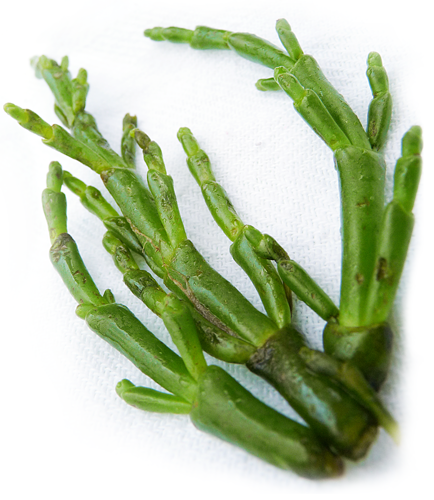
Samphire is a type of succulent, perfect for tolerating the salt from each inundating tide. It has short branching stems, with a strange joint-like structure that reminds me of little alien antennae.
As I don’t live on the coast, I don’t often get the chance to buy it. It’s a rare thing to find in the shops around my way, so I almost fell over with excitement when the fish stall at my monthly farmers market was selling it. I bought a couple of generous man-sized handfuls.
Good, fresh samphire should be bright green and shiny, still engorged with moisture. Avoid any that looks dull or withered. It should also smell fresh, tinged with the scent of sea air.
Before eating, it is important to wash it thoroughly in cold water to remove any gritty sand and silt. I took three good washings and drainings to get mine clean.
Samphire doesn’t take much cooking, you can indeed eat it raw, but I like to drop it briefly into boiling water, drain and toss in butter. Don’t add salt to the water and use unsalted butter – the samphire has been seasoned perfectly well by the sea. Finish with a grind of black pepper and eat.
Obviously, samphire is an ideal accompaniment to fish, being juicy, clean flavoured, with just a hint of the briny blue. The very essence of all that is good about our wild coastline.
Labels:
"Spouse Specials",
Coast,
Fish,
Marsh,
Marsh Samphire,
Salt Marsh,
Saltmarsh,
Samphire,
Sea,
Shellfish,
Vegetables,
Wild Food and Foraging
Saturday, 2 May 2009
Thai (style) Red Curry with Chicken and Prawns

You've probably noticed that I refer to this dish as a Thai 'style' curry, that's because it is my adaptation of an authentic recipe. I really like Thai curries as they are usually quite fresh in taste and I think it's probably the use of lemongrass and fish sauce that gives them a flavour character that sets them apart from Indian curries.
In my exploration of Thai cuisine I found a book in our local charity shop for £5. It's a weighty tome and at that price I just couldn't leave it on the shelf. I have certainly enjoyed reading it. Thai Food by David Thompson is a very comprehensive and informative resource, and now there's not much I don't know about the country's cooking and ingredients. However, there is the small problem of not being able to find those ingredients where I live. I expect if we were to to have well stocked asian supermarket, I would be racing back home with my bag stuffed with snake beans, pea eggplant, pandanus leaves, and water mimosa, but sadly there's nothing like that at my disposal. With that in mind I often choose to make the recipes where I can readily find the components or I adapt them to suit what I can get hold of. Sometimes, it's even difficult to find those Thai cooking kits in the supermarket so I often have to substitute the galangal and use ginger instead.
In the following recipe's instructions you will notice that I suggest using a pestle and mortar to make the paste. You could try using a liquidiser or something similar, but I think that because there's such a small amount, an electric kitchen device would be ineffective. Also pounding and grinding by hand gives a more desirable texture even if it does make a lot of noise and is quite hard work!
for the curry paste
2 long red chillies, deseeded, roughly chopped
1 stem lemongrass, chopped finely
1 inch piece ginger, grated
2 cloves garlic, peeled and grated
1 tablespoon coriander stalks, finely chopped
1/4 teaspoon ground white pepper
the rest…
2 tablespoons vegetable oil
1 small onion, finely chopped
2 chicken thighs, skinless and boneless, cut into inch pieces
1 sweet red pepper such as a capsicum or romano, deseeded and cut into strips
hot water
1 tablespoon fish sauce
4 kaffir lime leaves, dried is fine
1 can coconut milk
1 teaspoon brown sugar
juice of 1 lime
salt to taste
200g raw king prawns
handful coriander leaves, roughly chopped
Method
First make the curry paste.
Using a pestle and mortar, pound the chillies and lemongrass until they are quite fine in texture and reduced to a pulp. Then add the ginger, garlic and coriander stalks and continue to grind until pulped and combined. Finally add the pepper and stir to mix in. Set aside.
Heat the oil in a wok or large frying pan and add the onion, Cook gently until soft, then tip in the curry paste. Stir-fry the paste with the onions until the raw smell of garlic disappears.
Add the chicken and stir-fry for a minute or so until it becomes coated in the spice mixture, drop in the kaffir lime leaves and sweet red pepper strips and pour in some hot water, about enough to scantly cover the meat. Simmer for about 10 minutes until the meat is cooked and the liquid had reduced.
Stir in the coconut milk, sugar and lime juice and continue to simmer, giving it an occasional stir until the sauce has reduced and thickened and become a darker shade.
Add the prawns and heat gently until they turn pink and cooked through.
Finally taste and add some salt if you think it needs it. Stir through the chopped coriander and serve with some steamed Thai jasmine rice and wedges of lime to squeeze over.
Food photo taken from the book
Buy the Book and the Tools
Subscribe to:
Posts (Atom)