Showing posts with label In the Media. Show all posts
Tuesday, 14 June 2011
Ripe for Picking
Summer has truly arrived when English strawberries are ripe and ready for picking and although they are now available all year round – with foreign countries supplying our needs – you really can’t beat the fruit from our own soil. For me, reserving them as a seasonal treat makes them so much more special.
I grow a few strawberry plants in my garden and there’s nothing more exciting when lifting up the leaves to find the stems swathed in red juicy jewels. If you’re not much of a gardener or simply lack the space, you can still experience the thrill of the strawberry hunt by visiting one of the many pick your own farms in the area.
When the sun is warm the sweet fragrant smell wafts into the air tempting even the most restrained of individuals to sneak a strawberry into their mouths whilst foraging.
The first berries are not often the sweetest though, I think they lack the depth of flavour that the prolonged spells of sun can give them, that said, I do still love to eat then unadorned. No sugar, no cream, just pure fruit bliss. Plucked straight from the plant whether homegrown or ‘stolen’ they just seem to taste better.
However, dairy produce does create a natural harmony, whether it’s cream, yogurt, creme fraiche or marscapone, you can’t go wrong, but I would never cook a strawberry unless it was in a jam of course.
Strawberries and Cream Sponge Cake
This is the sort of thing I like to make for a summer Sunday treat, just perfect for all the family to enjoy or for when you have friends over.
A light buttery sponge filled with the sweetest of English strawberries and billowing clouds of cream is hard to resist.
Ingredients
200g unsalted butter, softened
200g caster sugar
3 large eggs
2 tsp vanilla extract
200g self raising flour
half teaspoon baking powder
1-2 tablespoons milk
strawberries, hulled and halved lengthways, reserve some whole for decorating the top of the cake
6 tbsp good quality strawberry jam
300ml double cream, lightly whipped
icing sugar to dust
Method
Preheat the oven to 180C / Gas 4.
Grease two 18cm sandwich tins and place a circle of baking parchment in the bottom of each one.
With an electric food mixer beat together the softened butter and sugar until it becomes pale and creamy.
Whisk the eggs and vanilla extract in a jug until slightly frothy.
With the mixer still running, add the eggs by pouring very slowly in a thin stream into the butter and sugar mix. When the mixture is pale, and increased in volume, stop the mixer.
Sieve in a tablespoon of the flour and using a metal spoon carefully fold in to avoid knocking out any air.
Repeat, adding a spoonful at a time until all the flour and baking powder is incorporated.
The mixture should be of a soft dropping consistency. If it seems too stiff, gently fold in some milk.
Divide the mixture between the two cake tins and spread out evenly, smoothing off the tops.
Place in the centre of the oven for 25-30 minutes.
The cakes are ready when they're risen, golden brown and their edges are pulling away slightly from the sides of the tin.
Turn them out on to a cooling rack and carefully remove the baking paper. Leave until completely cool before filling.
Spread one half of the cake with strawberry jam and arrange the strawberry halves over it. Spread over the whipped cream and carefully place the other cake half on top. Arrange some whole strawberries on the top and dust lightly with sieved icing sugar.
Strawberry Facts
There are about 200 seeds in every strawberry.
A 100g serving contains just 50 calories.
In medieval times they were considered an aphrodisiac.
They can help to whiten your teeth.
They are full of a substance called ellagic acid which can help fight cancer.
Eight of them contain more vitamin C than an orange.
They are a member of the rose family.
They were cultivated by the Romans as early as 200 BC.
They can also be white or yellow and some even taste like pineapples.
Food photos: ©childsdesign 2011
My article previously published in Letchworth Living magazine. (June 2011 edition) www.letchworthliving.co.uk
Thursday, 19 May 2011
Beyond the Garnish
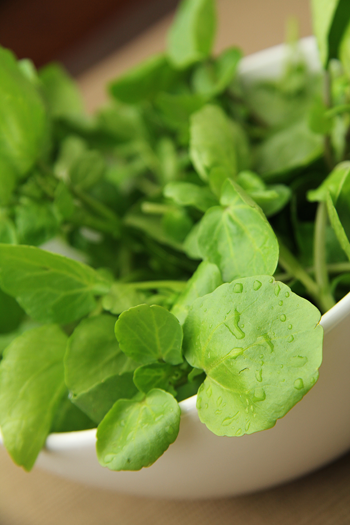
Could watercress be the next superfood? Historically it is known to be a blood cleanser and more recently there have been suggestions that it could help to suppress certain cancers. Watercress does indeed contain lots of vitamins and minerals as well as antioxidant properties which are all good for our health. That said, it tastes so good and is versatile enough to be used in so many ways that it shouldn’t need to be bolstered by a health PR campaign to make us eat it.
It may be an acquired taste for some people, the peppery flavour can be quite strong and might be a shock to younger palates. My Dad used to stuff it generously into sandwiches, but it was only after several tries that I grew to like it.
Hertfordshire has long been known for commercially cultivating watercress, the Sansom family have been doing so for five generations and Nine Wells Farm in Whitwell near Hitchin, is probably the closest producer to us here in Letchworth.
It is nice to think that we have a plentiful supply on our doorstep, so expect to find it in local delicatessens, farm shops and greengrocers. I have even found bags of supermarket watercress with ‘Herts’ as the place of origin, so you never know.
May sees watercress being celebrated with its very own ‘week’, the perfect time to explore this humble leafy plant. Experiment with it and don’t just leave it to languish as an undervalued salad garnish on the side of the plate.
Having such a robust almost mustard-like taste, it can be used very much as an ingredient, giving flavour as well as the crunchy juicy texture coming from the stalks.
Try it roughly chopped and stirred through mashed potatoes or it makes an interesting filling for an omlette along with some mushrooms and Stilton cheese.
I’ve even made pesto using it, instead of basil, which is lovely stirred through some pasta with smoked salmon.
Watercress Soup
To extract all the gorgeous green goodness, a watercress soup is refreshing and an ideal lunchtime treat, but it is also elegant enough to serve as a dinner party starter.
Take care not to overcook the soup once the watercress is added as this will destroy the flavour and the colour may not be so appealing.
Ingredients
1 onion, peeled and roughly chopped
25g butter
250g potatoes, peeled and diced
600ml chicken or vegetable stock
2 x bags (about 150g) of watercress, roughly chopped
50ml cream
a little milk if needed
salt and black pepper
Method
In a large pan gently melt the butter, add the onion and cook the onion until soft and translucent but not browned.
Add the potatoes and stock and cook until the potatoes are soft, for approximately 15-20 minutes. When potatoes are almost cooked, add the watercress and cook no longer than 5 minutes. Tip into a liquidiser, add the cream and blend until smooth. Use a little extra milk if the soup seems too thick. Season with salt and black pepper and serve hot. Drizzle with some extra cream to serve.
Food photos: ©childsdesign 2011
My article previously published in Letchworth Living magazine. (May 2011 edition) www.letchworthliving.co.uk
Wednesday, 20 April 2011
Pure Pastures, Rare Flavour
My third article published in the local magazine, Letchworth Living. (April 2011 edition) www.letchworthliving.co.uk
Cheeky Spouse gets acquainted with her food at Offley Hoo Farm.
I wanted to find out just what a real farm is actually like, especially as I'm very much a 'towny', but I feel I need to see more than just an idyllic portrayal of one. Today was to be very educational, to say the least, as I set out to build more of a relationship with what I eat.
If you live in Letchworth, you'll no doubt have driven along the A505 between Hitchin and Luton and seen the wide expanses of countryside, with its undulations covered in lush green or the golden glow of oil seed rape, this landscape is the product of a good farming ethic carried out by Offley Hoo Farm’s award-winning farmer Jon Birchall. Of the 7000 acres covering the King's Walden estate, Jon manages 2000 acres following practices to fulfill the requirements of the High Level Stewardship Scheme.
Sunday morning is blessed with some fine sunshine, a brief but welcome brightness in what has been a largely dull week. Turning the car in to the entrance, I spot Jon hosing down the yard, as I get out, a friendly and inquisitive Border Collie trots up to greet me. When I bend down to stroke the dog, I get the feeling Jon nearly always takes second place when visitors arrive.
Jon is an extremely affable chap and is more than happy to tell me about the farm he manages. Although I've lived in the area for over 20 years, there's always something new and interesting to learn. The vast King's Walden estate covers two distinct soil terrains one lies just over the very end of the chalk of the Chilterns and both give rise to prime pasture.
I’m shown a map dating from around the 1920’s which clearly marks out all the fields. Knowing in the past, many fields were enlarged by grubbing up the hedgerows, I ask if the landscape has changed much over the years. Jon explains that even today, little has altered and in fact many of the smaller fields have endured modern farming.
We get into the truck for a tour of the estate, this is also a good time to check on the animals out in the fields – the native rare breed cattle, sheep and pigs produce some of the best local beef, lamb and pork. Our journey takes us out onto a muddy farm track past a rapeseed oil crop, where a clever device mimicking a bird of prey, swoops over the field to deter pigeons making a meal of the new shoots. When this crop is mature its seeds will be crushed to extract the oil which can be used for cooking or to make margarine.
The trip takes in a huge area and Jon points out his various fields describing how he’s transformed some of them from arable crop land to grass pasture. He explains how boundary margins (uncultivated strips around fields) prevent overspill of fertilisers and pesticides into the surrounding hedgerows and also points out a beetle bank, a long, low grassy mound. Areas like this are left to allow wildlife to flourish, particularly insects. Being part of the Stewardship Scheme means that farmers are actively involved in maintaining and improving countryside habitats throughout their work on the land.
It is easy to take our local landscape for granted, but only now do I fully appreciate how and why it looks the way it does. Hedge planting is carried out and land left to naturalise so that the native flora can return.
You may be asking, “what has this got to do with meat?” Well, good grazing and great care make for superior tasting meat.
At Offley Hoo, Jon has chosen livestock that are well suited to the environment. The animals are relatively easy to care for and economical to rear, but superior in every way.
Jon stops at a barn where Longhorn cattle have been brought in for the winter. They are truly magnificent animals. They do indeed have long horns, but seem gentle enough. Not often having had the opportunity to see cows this close up, I’m surprised at how thick and wavy their coats are. There are a few calves still suckling from their mothers and despite their cuteness I don’t feel at all fazed by the fact that I’m looking at what is potentially my dinner.
Offley Hoo’s Wiltshire Horn sheep roam happily in fields over the farm and when I visit, many of them are pregnant, so by the time you read this they may have already given birth to their lambs.
They grow to quite a heavy weight without putting on excess fat and the meat is full flavoured which makes it very desirable to discerning consumers.
After returning to the yard, Sarah (Jon’s wife) takes me to see the piglets. They are Large White/ Middle White crosses and perfectly adorable as they run around and climb all over one another. I’m relieved they are locked in a stable as mother pig looks quite protective.
It may seem odd to be eating rare breeds, but if we didn’t, they simply wouldn’t exist. The rearing of old native breeds for meat, is in effect a conservation programme which in turn is better for the animals, environment and us.
For more information about the farm and meat sales visit:
www.offleyhoofarm.co.uk
Open Farm Sunday
Each year Offley Hoo opens its gates to the public as part of a nationwide event to give people the opportunity to get in touch with the land that feeds us. There will be lots of activities including a chance to meet the animals, tractor rides and a food market.
This year it will be held on the 12th June and should be a great day out for all the family.
www.farmsunday.org
Photos: ©childsdesign 2011
Cheeky Spouse gets acquainted with her food at Offley Hoo Farm.
I wanted to find out just what a real farm is actually like, especially as I'm very much a 'towny', but I feel I need to see more than just an idyllic portrayal of one. Today was to be very educational, to say the least, as I set out to build more of a relationship with what I eat.
If you live in Letchworth, you'll no doubt have driven along the A505 between Hitchin and Luton and seen the wide expanses of countryside, with its undulations covered in lush green or the golden glow of oil seed rape, this landscape is the product of a good farming ethic carried out by Offley Hoo Farm’s award-winning farmer Jon Birchall. Of the 7000 acres covering the King's Walden estate, Jon manages 2000 acres following practices to fulfill the requirements of the High Level Stewardship Scheme.
Sunday morning is blessed with some fine sunshine, a brief but welcome brightness in what has been a largely dull week. Turning the car in to the entrance, I spot Jon hosing down the yard, as I get out, a friendly and inquisitive Border Collie trots up to greet me. When I bend down to stroke the dog, I get the feeling Jon nearly always takes second place when visitors arrive.
Jon is an extremely affable chap and is more than happy to tell me about the farm he manages. Although I've lived in the area for over 20 years, there's always something new and interesting to learn. The vast King's Walden estate covers two distinct soil terrains one lies just over the very end of the chalk of the Chilterns and both give rise to prime pasture.
I’m shown a map dating from around the 1920’s which clearly marks out all the fields. Knowing in the past, many fields were enlarged by grubbing up the hedgerows, I ask if the landscape has changed much over the years. Jon explains that even today, little has altered and in fact many of the smaller fields have endured modern farming.
We get into the truck for a tour of the estate, this is also a good time to check on the animals out in the fields – the native rare breed cattle, sheep and pigs produce some of the best local beef, lamb and pork. Our journey takes us out onto a muddy farm track past a rapeseed oil crop, where a clever device mimicking a bird of prey, swoops over the field to deter pigeons making a meal of the new shoots. When this crop is mature its seeds will be crushed to extract the oil which can be used for cooking or to make margarine.
The trip takes in a huge area and Jon points out his various fields describing how he’s transformed some of them from arable crop land to grass pasture. He explains how boundary margins (uncultivated strips around fields) prevent overspill of fertilisers and pesticides into the surrounding hedgerows and also points out a beetle bank, a long, low grassy mound. Areas like this are left to allow wildlife to flourish, particularly insects. Being part of the Stewardship Scheme means that farmers are actively involved in maintaining and improving countryside habitats throughout their work on the land.
It is easy to take our local landscape for granted, but only now do I fully appreciate how and why it looks the way it does. Hedge planting is carried out and land left to naturalise so that the native flora can return.
You may be asking, “what has this got to do with meat?” Well, good grazing and great care make for superior tasting meat.
At Offley Hoo, Jon has chosen livestock that are well suited to the environment. The animals are relatively easy to care for and economical to rear, but superior in every way.
Jon stops at a barn where Longhorn cattle have been brought in for the winter. They are truly magnificent animals. They do indeed have long horns, but seem gentle enough. Not often having had the opportunity to see cows this close up, I’m surprised at how thick and wavy their coats are. There are a few calves still suckling from their mothers and despite their cuteness I don’t feel at all fazed by the fact that I’m looking at what is potentially my dinner.
Offley Hoo’s Wiltshire Horn sheep roam happily in fields over the farm and when I visit, many of them are pregnant, so by the time you read this they may have already given birth to their lambs.
They grow to quite a heavy weight without putting on excess fat and the meat is full flavoured which makes it very desirable to discerning consumers.
After returning to the yard, Sarah (Jon’s wife) takes me to see the piglets. They are Large White/ Middle White crosses and perfectly adorable as they run around and climb all over one another. I’m relieved they are locked in a stable as mother pig looks quite protective.
It may seem odd to be eating rare breeds, but if we didn’t, they simply wouldn’t exist. The rearing of old native breeds for meat, is in effect a conservation programme which in turn is better for the animals, environment and us.
For more information about the farm and meat sales visit:
www.offleyhoofarm.co.uk
Open Farm Sunday
Each year Offley Hoo opens its gates to the public as part of a nationwide event to give people the opportunity to get in touch with the land that feeds us. There will be lots of activities including a chance to meet the animals, tractor rides and a food market.
This year it will be held on the 12th June and should be a great day out for all the family.
www.farmsunday.org
Photos: ©childsdesign 2011
Wednesday, 9 March 2011
Quite a Catch
My second article published in the local magazine, Letchworth Living. (March 2011 edition) www.letchworthliving.co.uk
Cheeky Spouse finds the best of British fish on our doorstep
I absolutely love fish and can’t understand why us British don’t eat more of it. There we are, a group of islands, surrounded by the bountiful sea and we shun what those waters offer up.
For those who do eat fish regularly, there is more than just cod or haddock and as these species are in decline we really do need to think about what we buy.
Recently I went to visit North Hertfordshire's only independent fishmongers, Fish at the Fox, in Willian, which opened last November and occupies the site of what used to be The Food Barn.
It is a grey and rainy day, not at all conducive to high spirits. We park the car in one of the many spaces and dash the short distance to the unassuming white door of the shop. It’s a relief to be in the dry, and the bright and airy interior soon dissolves away the effects of the British elements.
Standing behind the shiny glass counter is Marc Howard who is a great authority on fresh fish. As we're about to shake hands, Marc pauses briefly to wash his hands, having just prepared some sea bass fillets. All clean, we can now carry on with our introductions.
It is clear to me that Marc is passionate about what he sells and knows his stuff. Everything sold at Fish at the Fox is sourced from British waters where possible and Marc assures me that sustainability and seasonality are very important to him. It would be highly unlikely that you'd see an Icelandic cod residing in the counter. Endangered species are avoided completely.

The shop is open from Wednesday through to Saturday and Marc gets new stock in on Wednesday morning and every day if necessary to ensure it’s as fresh as possible. Nothing has had to come too far, either from our East Anglian or south coasts, and Marc can tell you exactly where any of his fish has been landed and by whom. I doubt you'd get that sort of detail from your supermarket. On the wall, behind the counter, pictures of the fisherman that supply the shop, are proudly displayed; a weather beaten Ben, Paul, Cyril and then there’s Richard, who keeps Marc in plenty of oysters and mussels from Brancaster in Norfolk. Seeing the men's coast worn faces really makes you appreciate how your fish gets to your plate.
Casting my eyes over the tempting fish resting on the crushed ice, I start imagining the delicious ways I could eat them. To some, the display could be a shock if you're particularly squeamish. Everything is presented whole, head on and eyes staring. Personally I prefer to see fish this way, you can see how fresh it is – bright gills, shining eyes and moist glistening skin, a confidence that cannot be gleaned from a pre-packaged fillet.
As I examine the brill, gurnard and megrim it occurs to me that I've never even tasted these varieties, not because I’ve not wanted to, but more that I've never been able to obtain them.
Fish can be ugly looking creatures, but I fell in love with the gurnards. Call me a softy, but they have an adorable puppy-like quality to their faces, weird but kind of cute.
Also today, there's a fearsome-looking but chunky hake, a huge sea bass, a prepared meaty monkfish tail, some sizeable skate wings and a group of sardines shimmering like precious silver darts. A bulging net of Palourde clams from Poole nestles at the back. The stock varies from week to week, but a quick phone call or checking on Fish at the Fox's Facebook or Twitter pages will keep you up-to-date with what's in stock.
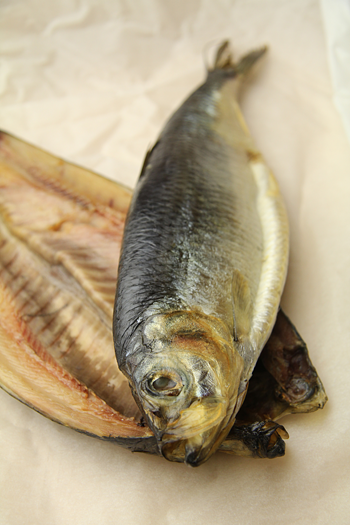
There’s smoked fish too, from Suffolk smokeries. The kippers look very appetising, the whole fish split open has a rich tan colour. It’s properly smoked in the traditional way, a far cry from those often luminous yellow things which have been flavoured with something more laboratorial and shrink-wrapped in plastic with a pat of butter.
A richly hued side of salmon, whole mackerel and trout sit along side. My mouth is already watering and I'm adding them to my mental shopping list.
These fish have been suffused with the flavour of real smoke, the result of having been sat in a black tar-walled shed, filled with the swirling plumes from smouldering
oak chippings.
My lengthy, yet enjoyable chat with Marc reveals what a friendly and helpful chap he is. Keen to show me the latest catch he lovingly lifts the fish from the counter and describes its texture, flavour and even suggests the best cooking methods. We both agree that fish should be done simply and avoid overcooking. To assist customers, there are a number of recipe leaflets on the counter to pick up and take home. All this reflects the care and attention to the produce and the customers.
While I'm there some customers do arrive, and one particular man is so over the moon to pick up his order of crab and oysters, it makes me feel warm and fuzzy inside.
Perhaps I'm a little strange to be so sentimental, but it is touching to be in the company of people who appreciate good produce.
For those not able to make it to the shop, Fish at the Fox now offer a local delivery service. If you live in the Letchworth or Hitchin area and your order is over £15, Marc will deliver for free, bringing fresh fish direct to your door. Now that's a personal touch.
www.fishatthefox.co.uk
Photos: ©childsdesign 2011
Featured on The Artisan Food Trail
Cheeky Spouse finds the best of British fish on our doorstep
I absolutely love fish and can’t understand why us British don’t eat more of it. There we are, a group of islands, surrounded by the bountiful sea and we shun what those waters offer up.
For those who do eat fish regularly, there is more than just cod or haddock and as these species are in decline we really do need to think about what we buy.
Recently I went to visit North Hertfordshire's only independent fishmongers, Fish at the Fox, in Willian, which opened last November and occupies the site of what used to be The Food Barn.
It is a grey and rainy day, not at all conducive to high spirits. We park the car in one of the many spaces and dash the short distance to the unassuming white door of the shop. It’s a relief to be in the dry, and the bright and airy interior soon dissolves away the effects of the British elements.
Standing behind the shiny glass counter is Marc Howard who is a great authority on fresh fish. As we're about to shake hands, Marc pauses briefly to wash his hands, having just prepared some sea bass fillets. All clean, we can now carry on with our introductions.
It is clear to me that Marc is passionate about what he sells and knows his stuff. Everything sold at Fish at the Fox is sourced from British waters where possible and Marc assures me that sustainability and seasonality are very important to him. It would be highly unlikely that you'd see an Icelandic cod residing in the counter. Endangered species are avoided completely.

The shop is open from Wednesday through to Saturday and Marc gets new stock in on Wednesday morning and every day if necessary to ensure it’s as fresh as possible. Nothing has had to come too far, either from our East Anglian or south coasts, and Marc can tell you exactly where any of his fish has been landed and by whom. I doubt you'd get that sort of detail from your supermarket. On the wall, behind the counter, pictures of the fisherman that supply the shop, are proudly displayed; a weather beaten Ben, Paul, Cyril and then there’s Richard, who keeps Marc in plenty of oysters and mussels from Brancaster in Norfolk. Seeing the men's coast worn faces really makes you appreciate how your fish gets to your plate.
Casting my eyes over the tempting fish resting on the crushed ice, I start imagining the delicious ways I could eat them. To some, the display could be a shock if you're particularly squeamish. Everything is presented whole, head on and eyes staring. Personally I prefer to see fish this way, you can see how fresh it is – bright gills, shining eyes and moist glistening skin, a confidence that cannot be gleaned from a pre-packaged fillet.As I examine the brill, gurnard and megrim it occurs to me that I've never even tasted these varieties, not because I’ve not wanted to, but more that I've never been able to obtain them.
Fish can be ugly looking creatures, but I fell in love with the gurnards. Call me a softy, but they have an adorable puppy-like quality to their faces, weird but kind of cute.
Also today, there's a fearsome-looking but chunky hake, a huge sea bass, a prepared meaty monkfish tail, some sizeable skate wings and a group of sardines shimmering like precious silver darts. A bulging net of Palourde clams from Poole nestles at the back. The stock varies from week to week, but a quick phone call or checking on Fish at the Fox's Facebook or Twitter pages will keep you up-to-date with what's in stock.
There’s smoked fish too, from Suffolk smokeries. The kippers look very appetising, the whole fish split open has a rich tan colour. It’s properly smoked in the traditional way, a far cry from those often luminous yellow things which have been flavoured with something more laboratorial and shrink-wrapped in plastic with a pat of butter.
A richly hued side of salmon, whole mackerel and trout sit along side. My mouth is already watering and I'm adding them to my mental shopping list.
These fish have been suffused with the flavour of real smoke, the result of having been sat in a black tar-walled shed, filled with the swirling plumes from smouldering
oak chippings.
My lengthy, yet enjoyable chat with Marc reveals what a friendly and helpful chap he is. Keen to show me the latest catch he lovingly lifts the fish from the counter and describes its texture, flavour and even suggests the best cooking methods. We both agree that fish should be done simply and avoid overcooking. To assist customers, there are a number of recipe leaflets on the counter to pick up and take home. All this reflects the care and attention to the produce and the customers.
While I'm there some customers do arrive, and one particular man is so over the moon to pick up his order of crab and oysters, it makes me feel warm and fuzzy inside.
Perhaps I'm a little strange to be so sentimental, but it is touching to be in the company of people who appreciate good produce.
For those not able to make it to the shop, Fish at the Fox now offer a local delivery service. If you live in the Letchworth or Hitchin area and your order is over £15, Marc will deliver for free, bringing fresh fish direct to your door. Now that's a personal touch.
www.fishatthefox.co.uk
Photos: ©childsdesign 2011

Featured on The Artisan Food Trail
Friday, 4 February 2011
King of the Cookers
My first article published in the local magazine, Letchworth Living. (February 2011 edition) www.letchworthliving.co.uk
This month it’s Bramley Apple Week, a time to celebrate all that is great about this versatile and tasty apple.
Name me a typically British fruit and I’ll bet you'll say the apple, but there is one, I feel in particular, more deserving of the highest accolade, and that is the Bramley. I can't think of a better variety for cooking, with its sharp taste and melting texture, it is superior in every way. Tolerating just about any cooking process, the Bramley is able to retain its distinct appley flavour that other apples cannot match. The Bramley is a 'cooker' and 'king of apples' in the kitchen.
My Grandparents had a Bramley tree in their garden and Grandma would send me, her little helper, off to pick some when she was baking. "How many do you want?" I would ask. "Just two or three", she'd reply. That didn't seem enough, but when I got to the tree I could see why. The apples were huge and my hands could barely hold one easily. The branches, heavy with fruit, hung low enough even for a little girl to reach.
I would grasp one in both hands and twist the apple around, until it freed itself from the twig. The prodigious green fruit, all shiny with a hint of red blushing across its skin, smelled fresh and enticing.
History
The Bramley apple is just over 200 years old and sprung in to life when in 1809 a young girl by the name of Mary Ann Brailsford planted some pips in her Nottinghamshire garden.
Later in 1846, a local butcher, Matthew Bramley bought the cottage and garden, but it wasn’t until 1856 that the apple became properly established as a new variety. Henry Merryweather, a local nurseryman, asked if he could take cuttings from the tree and start to sell the apple. This was agreed by Matthew Bramley, who insisted that the apple bear his name – hence ‘Bramley’s Seedling’ as it’s properly known.
Bramley Apple Week
Every year, the Bramley is celebrated with an awareness week, and this year it will be held between 6–13 February.
Joining in the celebration of this versatile fruit The Bramley Campaign has enlisted the culinary talents of the BBC’s Great British Menu winner, Mark Hix to develop some delicious recipes.
In the Kitchen
There really is so much you can do with a Bramley. Cut into big chunks it makes a perfect filling for pies and crumbles of course, but it really does have so many uses for both sweet and savoury dishes.
Try them simply baked whole in the oven, just core them, score the skin around the equator of the apple (this prevents them bursting) and then fill the centres with a mixture of sultanas, cinnamon, and lashings of muscovado sugar and butter. Place them in an ovenproof dish and bake at 200C, Gas 6 for about 25 minutes until the apples puff up.
When they’re done the apple flesh will be gloriously fluffy and there will be lots of rich syrupy juices to spoon over.
They are also great made into chutney and go well with meats such as pork and game, they even work well with fish such as mackerel. The sharpness complements well by cutting through the oiliness.
Easy Apple Sauce
Next time you’re having roast pork or even just some humble sausages, try making my easy apple sauce to perk up your meal.
I can assure you that it is so simple to prepare and more delicious than the shop bought stuff.
Ingredients
500g Bramley apples
50g sugar
1 tbsp water
Method
Peel and core the apples, then slice them.
Place into saucepan with the water and sugar and cook gently, stirring occasionally until fluffy.
Leave to cool before serving.
For a dessert version, add raisins and some more sugar if required – this is lovely as a filling for pancakes or yogurt topping.
Best Ever Apple Crumble
Crumble is comfort food, and often a fond reminder of the good things about our childhood. I can’t think of anything nicer than a warm bowl of apple crumble served with a generous amount of custard to cheer me up.
To achieve the best results, I do recommend that you use butter (cold and hard, straight from the fridge) to make the crumble topping. Please do not be tempted to use margarine spread instead as this will not give you the right texture or indeed the taste.
Ingredients
For the apples
4 large Bramley apples
knob of butter
zest and juice of 1 lemon
175g caster sugar
a good pinch of cinnamon
For the crumble
125g unsalted butter
225g plain flour
140g caster sugar
Method
Preheat the oven to 200C, Gas 6.
Peel and core the apples and cut into big chunks.
Melt the butter in a large saucepan, add the lemon zest and juice, sugar, cinnamon and then drop in the apples.
Cook gently for about 5 minutes to soften slightly.
Tip the apple mixture into a large ovenproof baking dish and set aside.
Tip the flour into a large bowl and then cut the butter into smallish pieces and add these to the flour. Rub the flour and butter together using your fingertips until the mixture resembles coarse breadcrumbs. It is good if the mixture clumps together a little.
Add the sugar and stir in.
Spoon the crumble mixture over the apples, letting it fall loosely. Avoid squashing it down so that it remains light and fluffy.
Place in the preheated oven and bake for 30 – 40 minutes until a good golden brown.
Although Hertfordshire is not known for Bramleys in particular, it would be unfair not to mention two very local varieties.
Young’s Pinello
Letchworth’s very own dessert apple was raised by Miss Eva Young in the 1930s and is still available to buy as tree stock.
It is a medium sized apple with pale yellow skin with a scarlet flush and stripes and firm, aromatic sweet tasting flesh.
Hitchin Pippin
This apple dates back to 1896 but seems to have proved very elusive in tracing an original tree. It was feared that it may have been lost to history, but recent research by the Hertfordshire Orchard Initiative has found a tree that could re-establish the old variety.
Useful websites
Bramley Apple Weekwww.bramleyapples.co.uk
Hertfordshire Orchard Initiative
www.hertfordshireorchardinitiative.org.uk
East of England Apples and Orchards Project
www.applesandorchards.org.uk
Food photos: ©childsdesign 2010
Sunday, 30 January 2011
Cheeky Spouse in print: Letchworth Living
Starting next month (February), I'll be published with a regular monthly article in Letchworth Living magazine, a free glossy publication that is available to Letchworth Garden City residents and beyond.
I'm very excited, as this is such a wonderful opportunity to be able to share my writing with fellow locals.
I aim to cover aspects that relate to food and local food producers and it will offer me the chance to meet lots of new people in the process.
Thanks must go to Charn Badhan, the magazine's editor, who has taken me on board (does she know what she's let herself in for?!) and I can't say how much I appreciate it, enough.
For those not able to obtain a copy of the magazine it should be appearing online soon, with a brand new website. I'll also be posting the articles on my blog after publication date.
www.letchworthliving.co.uk
Labels:
In Print,
In the Media,
Letchworth Living,
Magazine,
Press,
Writing
Monday, 8 November 2010
Three Counties Kitchen
From left to right: Sara Abbott, Me, Nick Coffer (behind), Phil Fanning
I'm not the sort of person that readily steps in to the limelight, so when I was invited (through Twitter) to take part on a local radio programme I had some reservations. After some deliberation, I thought why not, it isn't everyday an opportunity like that comes along.
For my part in the programme I was requested to bring along two dishes I'd made, one main course and one dessert. Following a telephone conversation with the presenter, Nick Coffer we agreed that my Grandma's Victoria Sponge recipe would be good and then later I settled on making a winter warmer of Lamb Goulash with Caraway Dumplings. This was a good option as the dish needed to be reheated in the microwave when I got there.
I had a brilliant time once I got over the initial butterflies. It was lovely to meet some very nice people too. Phil Fanning, who is the head chef at Paris House in Woburn brought in some amazing and intricate dishes.
I actually got the chance to try some fine dining, albeit in the Luton radio studio. His chowder completely changed my mind about saffron, so I won't be shying away from that particular spice anymore. Phil's interesting take on Black Forest gateau was quite stunning too.
Sara Abbott a Master of Wine from Bedford brought in a refreshing English white wine from Kent. English wine has had a bad reputation in the past, but it has come a long way over the years, which her choice proved.
She also chose a full-bodied French red to go with my goulash, and it was a perfect partner indeed.
I got to talk about the dishes I made and I think, if I'd had the chance,
I would have talked about food for hours, but it's startling how fast two hours passes.
Anyway enough of my waffling, if you want to find out what I talked about, or to listen to Phil's chef secrets or Sara's witty wine chatter, you can listen to the programme on iPlayer up until the evening of Saturday 13th November.
The BBC iPlayer link is no longer available but you can listen to an edited version of the radio programme in my In the Media section. Click here.
If you're a foodie and live in the Herts, Beds and Bucks region, and would like to appear on the programme, just drop me an email and I can give you contact details.
Photo taken from BBC Three Counties Radio website
Labels:
BBC,
In the Media,
Radio,
Three Counties Kitchen,
Three Counties Radio
Friday, 5 November 2010
Cheeky Spouse on the Radio
Firstly, I can't quite believe it myself, but I am going to be taking part in a radio programme for BBC Three Counties Radio!
Three Counties Kitchen, which is to be broadcast live at 7pm on Sunday 7th November, is a two-hour long show all about food. Presented by Nick Coffer, who some people will know from his website mydaddycooks.com, Sunday's guests will be Philip Fanning, the head chef from the Paris House restaurant in Woburn, a local wine expert and little old me.
I have been invited to be the local home cook and for the evening's entertainment I have to take along two dishes that will be tasted in the studio. Philip Fanning will also be bringing in some dishes too, so it is with some trepidation, on my part, that my food will be tasted by an experienced chef. No pressure then!
I have been reassured by Nick, who seems like a nice chap, that it will be a fun and relaxed affair, so I should enjoy myself.
If you want to find out what I cook, and you're in the Herts, Beds and Bucks region you can tune in (info at top of post) or you can listen online, wherever you are.
Embarrassingly for me, the show will be available on BBC iPlayer for 7 days afterwards here, if you miss it.
Website: BBC Three Counties Radio
Labels:
BBC,
Cheeky Spouse,
Events,
In the Media,
News,
Radio,
Three Counties Radio
Subscribe to:
Posts (Atom)